Blending Practice

Once students learn letter sounds, they need lots of practice blending words together. There are a few different ways you can give this practice.

There are two main things that can make blending difficult for some children: auditory processing weakness and short-term memory weakness. You must ensure students are automatic with letter sounds as well. Often, times students are not automatic enough with some sounds, and it slows them down, and they are not hearing the blended word. You should not be discouraged from working with students on blending if they do not know all letters and sounds, however. It is our job to know the letters and sounds we have taught and that each student has internalized. Hold students accountable for what they know. Work with those sounds when practicing blending, while pushing them forward.

When working with readers on blending, you need to keep a few things in mind. Recognize that some sounds are continuous sounds while others are stop sounds. When students recognize this after modeling and discussion, it helps them fluently blend words.

When introducing CVC words to beginning readers, make sure to do so by modeling how to say the words without completely stopping between sounds. We have to make certain that our kids understand that the individual sounds in words blend together. This is also where Set For Variability comes into play. I discussed this in my last blog post.

One strategy that I have found helpful when a student is struggling with blending is teaching them to blend the first two sounds in a word together. This works with CVC words and words with blends and digraphs. The kids who have processing issues often mix up the last sound. Blending the first two sounds together helps alleviate some of the cognitive load. It also activates their word knowledge causing the brain to start making connections with possible words students have in their oral vocabulary and or reading and writing memories.
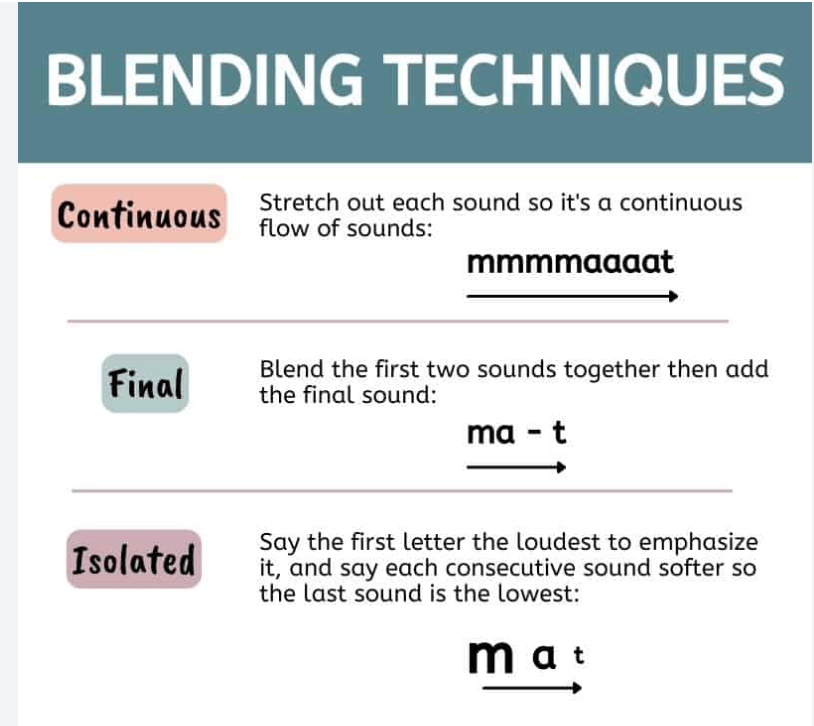
This can also make easier transitions when working with word chunks and words that rhyme. Our brain is always trying to make meaning and does so when learning to read by recognizing meaningful letter strings and chunks contained in words that can help us understand their meanings.

I have linked a blog post from Burkins & Yates discussing some other great things to keep in mind when teaching blending.

Enjoy, they offer some great ideas!

Troy

Set For Variability

You may have been hearing the term set for variability being used lately. It is a term often talked about within the science of reading movement. Research discussing Set for variability has been out for a while.

Set for variability refers to the ability to take an approximation error of a word and fix it into the correct word. Some are now labeling it as a strategy to help solve irregular words. It is more of a process readers must be able to perform. For Set for variability to be successful, a child must have phonemic awareness, and letter-sound knowledge, be able to decode and blend, and have a representation of the target word in her oral vocabulary (see Elbro, de Jong, Houter, D., & Nielsen, 2012). 

It also requires self-monitoring skills. Readers must be willing to do some self-teaching and take a leap, trying out the word in a slightly different way.

It involves the manipulation of sounds, adjusting the mispronunciation into a word they have heard that makes sense of the sentence. Notice how making meaning never goes away. Our brains naturally try to find meaning. 

Be aware that too much phonics and exposure to 100% decodable books will not allow students to use the process of Set for variability. Readers have to be exposed to words they cannot sound out early on. Not just High-Frequency words either. They must learn to play around with sounds in words and change mispronunciations into meaningful words. 

Here are a few helpful ideas to set your students up to learn this process.

As teachers, we have to coach kids into listening and switching the sound they say to something that gives the word meaning and sounds like a word they know and have heard

  • We can use phrases like “What else could it be” (Marnie Ginsberg)
  • Try it again
  • In their book Shifting the Balance, Burkins & Yates created a charge to help us teach kids to be flexible. I have provided a snapshot of it.
  • Help students use it with irregularly spelled High-Frequency words.

Words like: what, saw, was 

        I see 1st-grade readers try sounding out the word “what” all the time and then self-correcting after a brief pause, an example of students using Set for variability.  

        I recently worked with a struggling 3rd grader who got stuck on the word “tube.” First, he decoded it perfectly, but with a short sound. I asked him to try again and pointed to the e. He perfectly sounded it out again with the u saying its name. The long u sound is tricky, however, and it often does not perfectly say its name. I had to help him work through this. He was frustrated because he was following the rules he had been taught, and it was not working. I helped him use meaning and structure to make a leap to the correctly pronounced word.

A short a sound is often tricky for kids first learning short vowels. Think about the words am, ran, etc. The short a sound is not always pure.

So, teach students to first read with their eyes and say all the sounds in the word. If incorrect and their decoding attempt was phonetically accurate, have them use the sense-making processes we are more familiar with. They can cross-check the approximation they said with known words and for meaning.

Troy

Thinking about Word Study

I think there is a time and place for word sorts. When kids are sorting printed words, they look for differences in words. One issue with word sorts is that kiddos often sort without reading the words. Make sure to require kids to read the words as they sort them and after sorting.

When using word sorts, we often use them to teach a pattern or rime. However, we can also use them to help students recognize more words by sight. I will be doing more research on these two objectives for word sorts soon.

When completing Word Study activities, you need to understand your objective and know your students and how they learn. An alternative to word sorts is analogy charts. Here is a video showing how they work.

The objectives for analogy charts are to identify the vowel sound in a given word and use a word they already know to help them spell the word. This required encoding. Words sorts require decoding. Furthermore, Jan Richardson, the teacher in the video, has added a step to the analogy chart routine. At the end, the teacher, without saying the word, writes a challenging word (or two) that includes the targeted vowel concept on a dry-erase board. Students break the word up into chunks and read. For example, if you were doing an analogy chart for ow/ai from the video. A challenge word might be belowground, brainteaser, or arrowhead. There is value in doing word sorts and value in doing Analogy charts. Which one will have more of an impact on your objectives? Which one impacts a student’s ability to read (decode) and write (encode) words more?

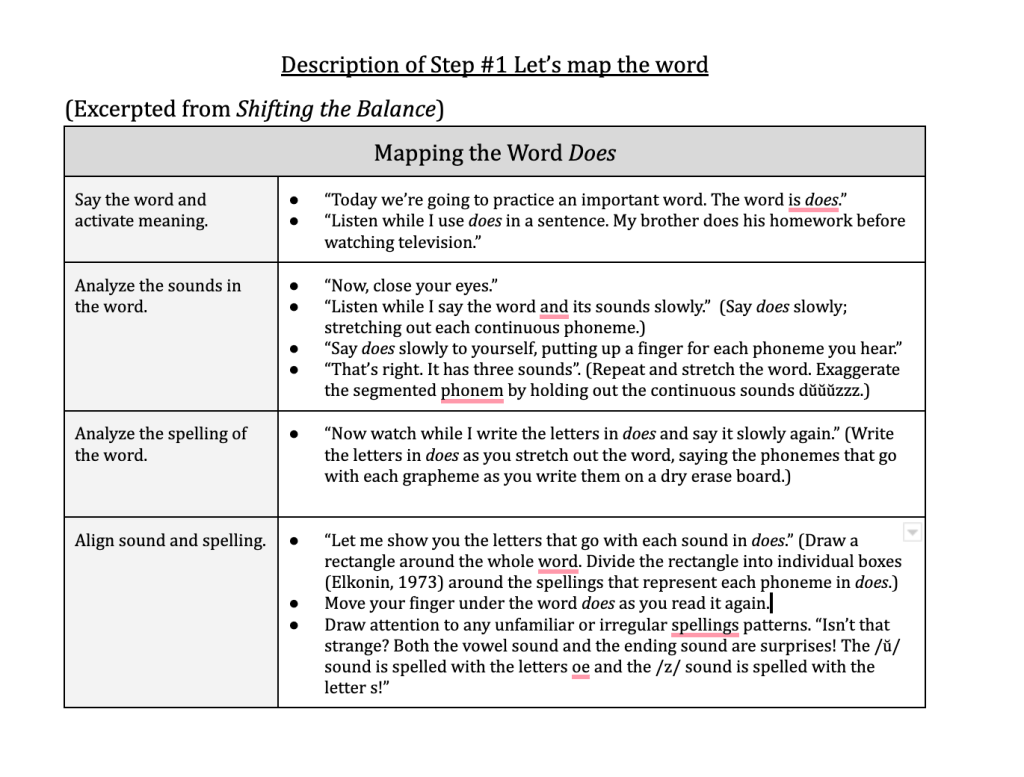
One thing I am trying out is Word Mapping. The technical term would be Grapheme Phoneme Mapping. You can use a form similar to this.

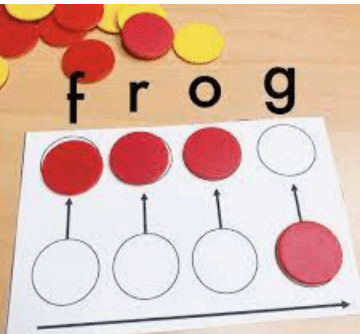
I ask students to repeat the target word after I say it. Then I ask them to tap it out on their fingers. They tap out words with 3-4 sounds on one hand by tapping a finger to their thumb for each sound heard in a word.

I ask how many sounds the word has, and then they write it. This is very similar to using Elkonon Boxes, often called Sound Boxes. When two or three letters represent one sound, they go in one box together. The word “see” above is an example of this.

When mapping words, you do not need to include words that follow a single pattern. Know your focus for the activity. Mapping words is an excellent way to review words or several patterns already taught.

Sunday Cummins and Jan Richardson have created a Mapping activity for high-frequency words. It has been added to the steps Richardson wrote about in her Next Step books. Click this link to find those books. This additional step is not in these books. Find it below. It was placed as step one, replacing What’s Missing as step one and moving it down to step two. The routine now has 5 steps.

Burkins & Yates (2021)

As you consider words with patterns for mapping, analogy charts, sorts, or other activities, keep in mind the students’ level of alphabetic knowledge. They are just not ready for some words, even when using analogies.


Also, understand that the sequence does matter when studying words. Do not overlook this. When building words, it is essential. You must make sure students attend to the feature you are working on. Understand that when it comes to working with words, the part of the word that we change or move when building words is the part students focus on. Therefore sequence matters! If working with vowel sounds, many teachers start with a list of short vowels and then move to long vowels. For example, they may ask them to read, write, or build this list of words: kit, bit, sit, kite, bit, site. This will cause the students to focus on what is changed, the initial consonant. Not the vowels. Sequence the words this way instead: kit, kite, bit, bite, sit, site. This focuses the student’s attention on how the e changes the vowel sound. You can do similar sequences for digraphs. Order matters.

Consider:

Words to build: kite, kit, bit, bite,hit, dim, dime, him

Words to read: dim, dime, time, tide, hid, hide

Words to write or map or use in an Analogy Chart: kite, kit, side, sit, site, dime, spit, spite

Children’s analysis of words is often very different than we realize. Don’t assume they notice, and note the same details in the words you expect them to. How they focus on words and what they see and hear depends on their current knowledge. We must observe and listen to them. When considering an activity, we must weigh its benefits against concerns. We cannot embrace an activity and assume it will work because it worked in a different setting with different students with their current level of knowledge. You can make those minor adjustments.


More to come on word sorts and analogy charts

Troy

The Front Porch

a community newsletter brought to you by the GRCC

KC LA

Kansas City Literacy Association

doctorsam7

Seeking Ways to Grow Proficient, Motivated, Lifelong Readers & Writers

Second Thoughts

Observations of a 2nd Grade Teacher

TWO WRITING TEACHERS

A meeting place for a world of reflective writers.

To Make a Prairie

A blog about reading, writing, teaching and the joys of a literate life

Pernille Ripp

Teacher. Author. Creator. Speaker. Mom.

sharpread

colbysharp@gmail.com

Crawling Out of the Classroom

In everything that my students and I do together, we strive to find ways to use reading and writing to make the world outside of our classroom a better place for all of us to be

sunday cummins

Experience Nonfiction

Reflect

Literacy